



NESTAWAY 8FT NESTING PRAM DINGHY SPECIFICATION:
Assembled length 8ft 2″ / 250cm
Beam 4ft 3″ / 130cm
Nested length 4ft 8″ / 142cm
Nested width 4ft 3″ / 130cm
Weight approx 100-lb (43kg)
INTRODUCTION
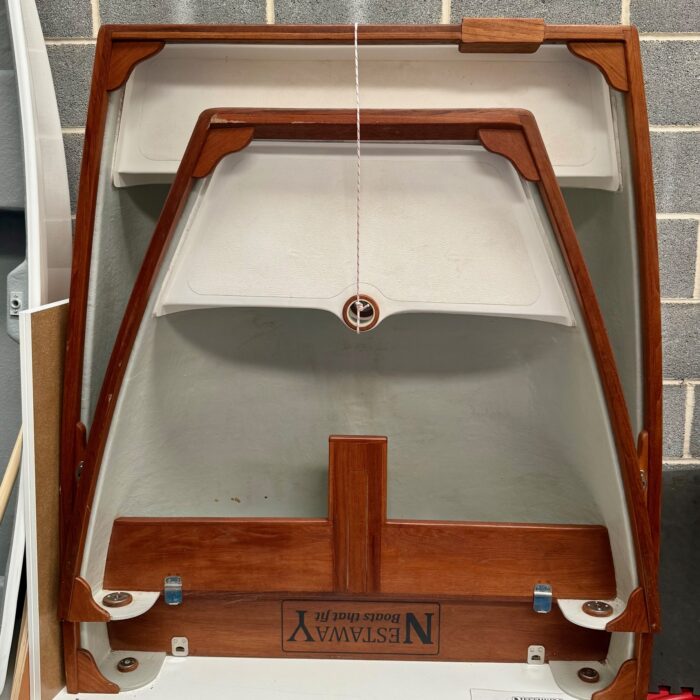
Our popular Nesting Pram Dinghy is 8ft 2″ long assembled, but only needs a space measuring 4ft 8″ long, by 4ft 3″ wide, to store. A suitable space can be found on the deck of most yachts over about 30ft, on top of Minis, or in the back of some estate cars.
The assembled Pram is 8’2″ (2.5m) long; the nested length 4’8″ (1.43m) and maximum beam 4’3″ (1.33m) tapering to 3’3″ (1m) at the stern. There are buoyancy tanks at both ends and the option of a longitudinal seat in the stern section helps give you the best balance between different loads.
The hull is made from glass fibre with wood trim.
ROWING
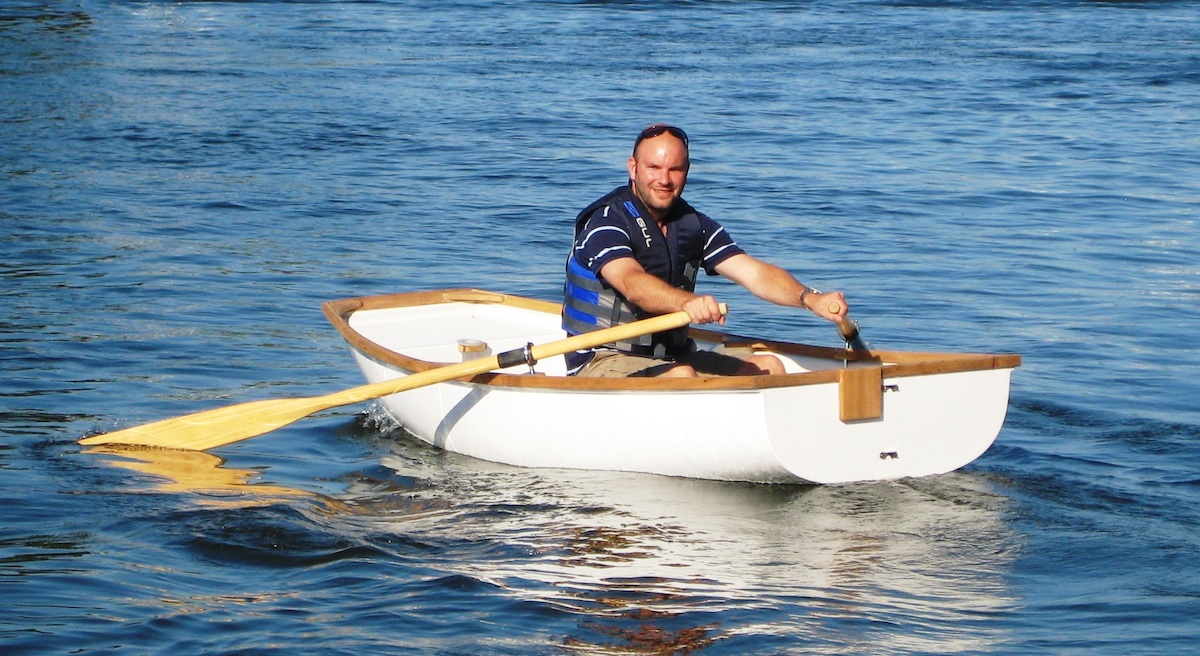
She is a delight to row, far outperforming most inflatable and folding boats, tracking straight but turning on a sixpence when you need her to.
If you are used to an inflatable, with one of our Pram Dinghies you will discover (or re-discover) that rowing can actually be a pleasant experience, and it will become something you do of choice rather than necessity. On many occasions it is also quicker to row ashore than fiddle about with the outboard, finding the petrol can etc.
“How refreshing it was to row a ‘proper’ rowing boat… the ease with which I got into my stride brought a smile to my face. Compared with an inflatable, the Nestaway is easily driven, quick to accelerate, effortless to keep going at a good speed… spins on a sixpence.” Sailing Today
SAILING A NESTAWAY 8FT NESTING PRAM DINGHY
The optional lugsail can be rigged either as a boomless “standing lug” – great for teaching kids or grandkids to sail – or a boomed “balanced lug” for a bit more performance. The boom actually makes most difference off the wind, rather than going to windward – it’s mainly a poling out spar. It’s a lot of fun and, whilst not aimed at racing, leaves most people pleasantly surprised. The mast is free-standing for quick, easy assembly (no fiddly shrouds and stays). See the slideshow to the right for more images.
The lug rig was chosen because it has a low centre of effort compared to the same sail area on a Bermudan rig – ie less heeling force – but in the words of one customer, also “pulls like a train!”. Because the hull is solid the rig’s power is converted into forward motion, rather than flexing.
MOTORING
If you want to motor she only needs a small amount of power to drive her along at displacement speeds. Motors of this size are much lighter and easier to handle, cheaper to buy and more economical to run, than the larger motors that tend to go with inflatables.
In a test by Yachting Monthly, she achieved just under five knots with a 2.3hp Honda and two passengers. We’ve had eight knots from 3.5hp, with just the driver on board, although it was a triumph of brute force over hydrodynamics (it is not a planing hull)!
Her flared bow will keep you much drier than most inflatables, deflecting spray and waves outwards.
The easily-driven hull also means that you will go faster or further or both if you choose an electric motor (such as the Torqeedo electric outboards we sell) – perfect for watching wildlife in peace and quiet. The fact that she rows so easily is also of great reassurance if you are worried about battery life.
Easily-driven, stable and dry under power. A tiller extension (pictured right) gives better fore and aft trim if you are motoring on your own.
STABILITY
She’s a fairly beamy shape, with lots of stability and load carrying ability for an 8ft dinghy. There is enough length in the aft section that the passenger’s legs won’t clash with the rower’s – in other dinghies this can be an amusing problem at first, but gets to be annoying on a daily basis.
“We did try to capsize… but couldn’t… even when standing right over on one side – something you’d never do – the stability was impressive” SAILING TODAY, September 2010
CAPACITY
With air buoyancy chambers fore and aft, there is sufficient buoyancy to keep the hull afloat even if fully swamped. Additional buoyancy bags can be fitted.
She is exempt from the RCD (Recreational Craft Directive) because of her length, but we estimate that she could rate in Category D, for 2-3 adults (this would require the additional buoyancy). The customer photo here shows a Nestaway Pram with 3 adults and 2 kids on board. It’s in calm conditions of course and we should point out this image is purely for illustrative purposes, not a recommendation. And yes they should all have been wearing life jackets. However we would also point out that there is still plenty of freeboard (hull above the water) and that there was no leak at the centre joint, ie the cut-away section of the joining bulkheads was still above the waterline. It was also still perfectly feasible to row – try that with an 8ft (2.5m) inflatable…
NESTAWAY 8FT NESTING PRAM DINGHY AS A YACHT TENDER
Most of our Pram Dinghies are sold as yacht tenders, generally for storage upside down on deck.
As a general guide the nested hull will fit on the foredeck or coachroof of most yachts from about 30ft and up. She is shown, top right, on the foredeck of a Bavaria 36, still with plenty of room to either side so that you can get forward. Note also the optional bilge keels/handles on the stern section: these are a convenient way to tie the dinghy down, and just the right height to hold onto as you walk past. This Pram also has the optional teak keel band, a good compromise between protecting the dinghy and not damaging the yacht’s deck (as a metal band might, particularly when gouged etc).
In this picture, right, a Pram is shown being dismantled on deck prior to nesting. The easiest way to launch/retrieve – certainly in calm weather – is a halyard to the towing eye and lifting the boat vertically. Not very dignified perhaps, but effective and quick!
TRANSPORTING
Many customers carry the 8ft Pram on the back of a camper van / motorhome, or even inside the garage found at the back of some of the larger “RVs”.
This picture shows a Pram Dinghy on a VW Transporter camper, bolted to one of our special towbar-mount platforms. It’s only a foot or so above the ground, and you only load half at a time – so it’s much easier than getting a single-piece boat up on the roof.
If you do need to get it on a car roof for transport purposes, lifting it there is OK for two adults. The Pram is actually quite aerodynamic upside down and when we need to put one on top of our van – because the inside is full, going to shows etc – we notice little if any difference in fuel economy! The stern section bilge keels/handles make useful tie-down points, guaranteeing a strap can’t slip.
Another option for cars with a relatively short span between the roof bars (the car in the bottom photo is a 2008 VW Polo hatchback) is to carry the Pram dinghy nested right way up.
You obviously need to be a bit careful about doing this in rain – she will potentially fill up to the lower bolt holes, which is quite a lot of water – but this massively reduces the overhangs front and back, making for a very stable load. Please tie down securely!
Reviews
There are no reviews yet.