


Offer


ePropulsion Navy Electric Outboards
£250.00 – £3,000.00
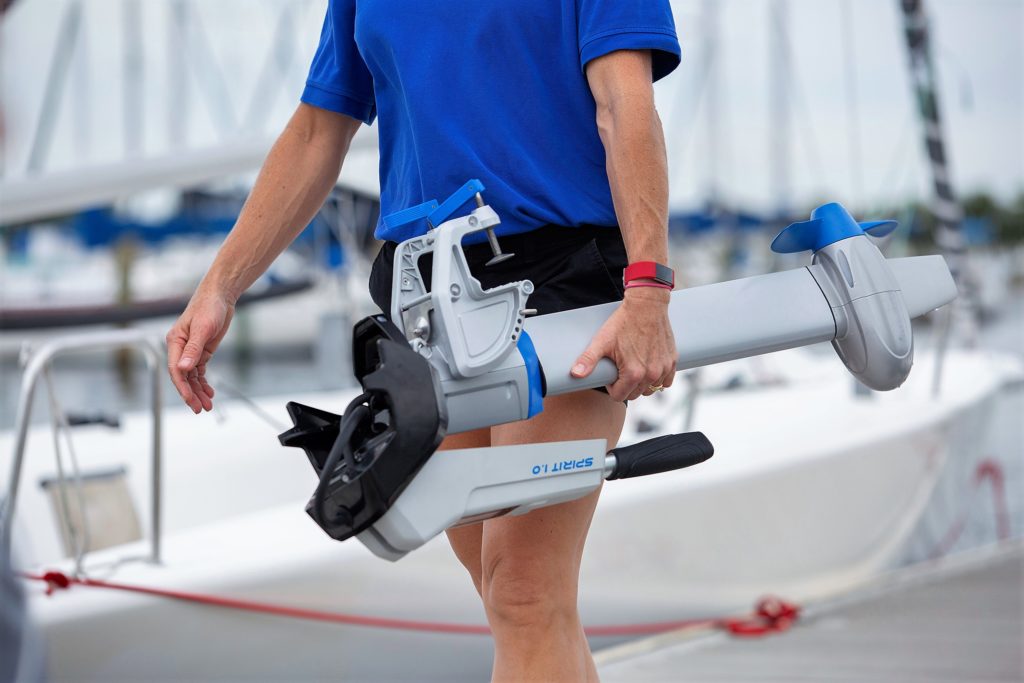
ePropulsion Navy Electric Outboards are quiet, smooth and efficient. Their immense torque
makes them suitable for powering displacement-hull vessels of up to about 5 tonnes.

Direct drive electric outboard
Unlike other electric outboards at this size (including Torqeedo Cruise), the Epropulsion Navy electric outboards all use direct-drive brushless DC motors. This means that the motors are directly connected to the propeller shaft, with no delicate/noisy gearbox in between. And the motor is housed underwater, in the “pod” at the bottom – so there’s no driveshaft or belt or cooling system running up the leg.
The main benefits of direct drive motors are very quiet (all-but silent) running, mechanical robustness/simplicity, and greater efficiency (meaning longer run times from your batteries).
These electric outboards are also incredibly easy to use – you just press the on button and twist the tiller handle or push the remote control lever, and off you go. No putting your back out (or knocking other crew out!) pulling the starter cord, no choke to fiddle with, no waiting around for it to “warm up” in case it stalls.
And being so mechanically simple there’s just less to go wrong, which you might have guessed means reduced servicing/maintenance costs. But it’s better than that, in fact no servicing is required (other than very basic DIY greasing etc). And unexpected repair bills are extremely unlikely, for example there’s no carburetor to gum up (the most common cause of petrol engine problems in recent years).


How powerful are they?
The direct translation of kW (kilowatts) to hp (horsepower) is 1.34. That would suggest the Navy 3.0 is equal to a 4hp petrol motor, and the Navy 6.0 to 8hp. BUT… electric motors have much more torque, from very low revs. To utilize that torque they turn relatively large propellers, relatively slowly, and that’s a very efficient way to drive a displacement hull. (Much more efficient than a small propeller spinning fast, as you get with a petrol motor.)
So in our experience the horsepower translation is about right if you want an outboard for a small fast dinghy, but underplays it if you want an outboard to drive a heavier displacement craft at displacement speeds. That’s how Epropulsion (and other brands) came up with saying their 3kW motors are “equivalent” (note not “equal”) to 5-6hp, and their 6kW outboards to 10hp.
Another factor that comes into play if you’re replacing an old petrol outboard is that most people never run them flat out, because it’s too unpleasant! That 10hp engine on the back of a small yacht might well never have been used above 6hp, for example.
We have now supplied Navy outboards for several “real world” installations, including small yachts and commercial users such as hire boats, passenger ferries and fishing boats. In all these cases, all requiring propulsion for displacement speeds, we’d say that 1kW replacing 2hp seems to be about right.
Using a Navy 3 on a fairly slippery (Swallow Yachts Bay Cruiser) 26ft yacht weighing two tonnes, that used to have a 9.9hp four stroke petrol outboard, we got:
- 4 knots at 750W output (surprising, but remember all that torque comes immediately)
- 4.5 knots at 1000W output
- 5 knots at 1500W
- 6 knots at full power 3000W
NB that last extra knot requires the same power as the first five, so if the previous 9.9hp engine was any faster it wasn’t much, we are up against hull speed by this point.
And on a 3.6m inflatable dinghy:
- a Navy 3 will achieve 6-7 knots even quite heavily loaded, but not quite planing speeds when lightly loaded
- a Navy 6 will achieve similar speeds heavily loaded, because you come up against hull speed again. It will get the boat on the plane with only one person on board, but not for more than an hour or so (as otherwise the weight of batteries makes it too heavy to plane!).
In summary then:
- for displacement-hull boats a Navy 3 will replace up to about 6hp, and a Navy 6 will replace up to about 12hp
- for light planing boats it’s more like what you’d expect, ie a Navy 3 is about the same as a 4hp petrol, and a Navy 6 about the same as 8hp.

How long will they run for?
This depends entirely on what capacity battery or batteries you fit – Navy motors are not supplied with batteries.
Many of us are used to “measuring” battery capacity in amp hours (for our car, boat or motorhome 12V systems), but it’s only a useful measure of battery capacity if you also know the voltage. The more useful – or “lowest common denominator of battery capacity” – is Watt hours or Wh, also sometimes expressed as kWh (1000Wh). You can find out the Wh for any battery by multiplying together the amp hours and the voltage.
If you have more than one battery wired together (in series or parallel) you add the Wh together to get the “bank capacity”. Please note that with lithium batteries – which is really what you want for electric propulsion – you can usually only wire together identical batteries.
Once you know the Wh rating of your battery or battery bank it’s very simple. If you’re using a 3kW motor at 1kW output, it will use 1kW or 1000W per hour. If your battery/bank capacity is 9kWh then it will last 9 hours at 1kW. But if you run the same motor at full power (3kW output) your 9kWh will only last 3 hours. Similarly the 6kW motor will also run for 9 hours at 1kW output, and 3 hours at 3kW, but only 1.5 hours flat out (because that’s drawing 6kW).

Building your ePropulsion Navy electric outboards system
For a complete working system you will need:
- Navy 3.0 or Navy 6.0 outboard.
- Your choice of tiller or remote control (see accessories for more detail)
- Your choice of 48V batteries. We recommend a minimum bank capacity of 3kWh for a Navy 3.0 outboard, and 6kWh for a Navy 6.0. The batteries can be of any type or make, but if you use the Epropulsion E-Series LifePo4 lithium batteries – the E60 or E163 – there will be more detailed and accurate battery information on the display of your tiller or remote control.
- Charger for batteries


How can we help?
We understand there is a lot of information to digest when trying to decide which product is for you. We have a lot of knowledge in this space and would love to help you make an impartial, informed decision.
Email: mail@nestawayboats.com or Phone: 0800 999 2535
Additional Information and Advice


Specification
Epropulsion Navy Specifications
Navy 3.0 EVO
£2000
*add tiller or remote
Power - 3kW
Input voltage - 39-60V
Shaft Length S - 47cm
Shaft length L - 59cm
Weight - 24.3kg
Navy 6.0 EVO
£2500
*add tiller or remote
Power - 6kW
Input voltage - 39-60V
Shaft length S - 47cm
Shaft length L - 47cm
Weight - 36kg
What you get in the box
The following items are supplied as standard with Epropulsion Navy 3.0 and 6.0 motors:
- motor
- main power cable (switched)
- remote steering link arm (you won’t need it if you use a tiller, but it’s in the box)
- propeller 10.2x6.7” with Navy 3, choice of 12.6x10.8” or 13.4x8.5” with Navy 6 (both included).
- wrench set to change propeller
Technical Drawings / Dimensions
Click below for downloads:
Accessories
Epropulsion Navy Accessories

EVO Tiller
The Navy motors can be used with a tiller or a remote control. The tiller has a display integrated into the housing, and requires a short cabled connection (included).
EVO Top Mount Remote Control
This remote control option has a display integrated into the main housing, and can operate the motor via Bluetooth or a cable (optional).
EVO Side Mount Remote Control
This remote control option has the handle and display as separate items, and requires a cabled connection (purchased separately).
EVO Communication Cable
This is what you need if you would like a cabled connection for your Top Mount Control, and is essential if you have chosen a Side Mount Remote Control. 5m long.
EVO Communication Cable Extension
If you are fitting a remote control with a wired connection, and it’s going to be more than 5m away from the motor, you need this extension cable, which is 5m long. You will also need (another) one if your motor is more than about 5m away from the batteries, if they are Epropulsion E-Series batteries and you wish to have a fully integrated system.
Be the first to review “ePropulsion Navy Electric Outboards”
You must be logged in to post a review.
You may also like…
Offer


Epropulsion Electric Outboards
£90.00 – £2,125.00
Reviews
There are no reviews yet.