
Advice, Inflatable Kayak
Our Guide to Choosing an Inflatable Kayak

New technology has greatly enhanced the rigidity, durability and performance of inflatable kayaks, but with so many on offer, how do you choose which inflatable kayak is right for you?
Please Note: we are not offering independent advice here, we are offering our opinion and that opinion is biased against products we don’t like! We would definitely sell more inflatable kayaks if we sold “cheap” ones, but we don’t because we don’t want to put people off kayaking and more specifically don’t want to put them off inflatable kayaks…
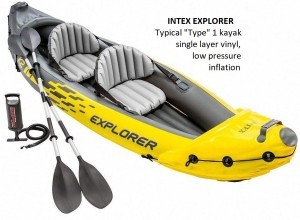
Type 1 Kayaks
You can buy something on Amazon or in Lidl that’s described as an “inflatable kayak package for two people” for £80 or so, sometimes even less. (Sometimes also a lot more, beware of this.) That’s for boat, paddles, and pump. We don’t think they’re very good, but we have to acknowledge they do float and do get people out on the water. It’s either astonishing or frightening (or a bit of both) that so much “stuff” can be purchased for so little money. Let’s do some quick numbers here. That price includes VAT so take that off (it goes to HMRC not the kayak retailer or manufacturer) and we’re left with £66. If it was on Amazon or ebay they skimmed off 10-18%. Then the kayak retailer needs to make some profit, the factory needs to make some profit, and there is quite likely an importer/distributor in there also wanting to make a profit. That might leave half (£33) at most for materials and labour. Not forgetting it also has to be put in a box, transported from factory to port, shipped several thousand miles across the world’s oceans, and then transported from destination port to the retailer. We are guessing a bit now but let’s allow £2 each for the paddles and pump (down to £27), £1 for the box, and £5 for all that transport… we’re left with £21 to make a kayak including seats, valves, skeg (if it has one) etc. So in fact it’s not even an £80 kayak, it’s a £20-at-factory-door kayak. How is that even possible?!
Well anyway, ignoring the maths, this cheapest category of kayak we’ll call Type 1. They are made of fairly thin single layer PVC, of the same type and maybe or maybe not a bit thicker than is used to make a lilo or swimming pool toy. The tubes can be inflated to 1 or 2psi max and they are plastered with warnings about not over-inflating them or leaving them in the sun inflated (because that will cause them to over-inflate). They will sag in the middle when you sit in them, so they’ll not be fast or easy to paddle. And in this category what’s called a two-person kayak is usually about 10ft long, which is actually 2ft shorter than the Aquaglide Chelan one-person kayak (where exactly are your legs meant to go?!). If you don’t know, if all else is equal, longer kayaks are more efficient: either faster for the same effort, or easier to get to the same speed, depending on how you look at it. But obviously it’s cheaper if you make it shorter, they have to make this thing for £20 remember.
All this said, Type 1 Kayaks do float and can be fun for mucking about off a beach on a sunny day, which may be exactly what you want. And if that’s the case, fantastic. Sorry we don’t sell them! If you want to paddle for more than a few minutes, ie go somewhere in your kayak, there are definitely better – but more expensive – options. AND PLEASE BE WARNED This type of kayak may be sold as low as £80 but is also subject to extreme price swings in time of shortage or high demand/peak season. At the time of writing, January 2021, the Intex Explorer pictured is $100 USD (about £80) on Amazon USA (presumably it’s in plentiful supply there) and… £319 on Amazon UK (the UK pretty much sold out of all kayaks in Coronavirus year). Same thing, same £20 at factory door kayak. Don’t pay £300 for it. (Edit 17 Aug 2021, Intex Explorer K2 currently £189 on Amazon UK, approx £120 on Amazon USA – still the same boat that was £80 in January!)
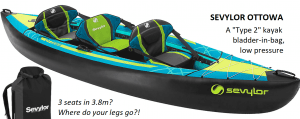
Type 2 Kayaks
The next step up in inflatable kayak world – lets’ say the £300 to £700 area – is where they use the same grade of material as Type 1 kayaks to make an airtight bladder, which is enclosed inside a “tough nylon skin”. They are often called double skin or covered kayaks. It’s easy enough to identify this type because the outside feels like fairly coarse fabric (it is!) rather than PVC, and there are long zips front and back to get the bladders in and out (for manufacture and repair purposes). They are definitely tougher and more puncture resistant than Type 1 kayaks but they still can’t take much pressure (they sag in the middle, but less than Type 1) and water gets between the layers which makes them heavier over time. Worst of all though they are a pain in the posterior to dry out after use. Nigh-on impossible to get completely dry in fact, so also over time they tend to go mouldy and/or rot and then fall apart from the inside – but you may well have thrown them away before that due to the smell.
If you can solve the drying issue and in most cases assume one person fewer than they say (as with Type 1, most Type 2 kayaks are afflicted by being too short) Type 2 kayaks are quite functional. A bit slow, a bit saggy, but you should get there. Although the author has just been reminded Type 2 kayaks also often (but not always) have differing valve types for the floor and tubes, which is just annoying… (it probably saves 20 cents at manufacture though).
If you’re shopping in the Type 2 price range you really need to look at the Spinera Hybris kayaks. These are genuine Type 3 kayaks for Type 2 money…
Type 3 Kayaks
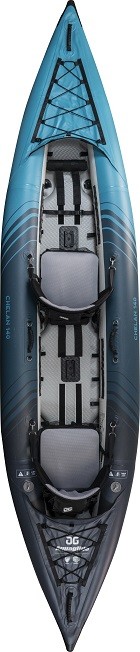 Here confusingly we go back to a single skin construction. But Type 3 single skin is completely different to Type 1 single skin. Arguably Type 3 kayaks are actually multi-skinned, but all the skins/layers are fused together in the material manufacturing stage, so water doesn’t get between the layers (like in Type 2 kayaks), not at all. There are often more, but at the very minimum there is an inner airtight layer, a middle reinforcing mesh layer, and an outer waterproof layer, all heat-bonded together to make a very strong fabric. The mesh middle layer is there to make the fabric almost impossible to rip, so this type of kayak can take much higher pressures (which makes the resulting hull stiffer) and is much less sensitive to variation in pressures (so won’t distort or go pop in the sun). This is the sort of fabric they use to make RIBs and other high-end inflatable boats… Type 3 Kayaks are made from the same materials as a RIB, just kayak-shaped.
Some – not all, but all the ones we sell – Type 3 Kayaks also utilise the latest dropstitch fabric technology. This uses the Type 3 fabric with the addition of stitches on the inside between the top and bottom, such that when you inflate it a flat panel is created (rather than a tube). These flat panels are incredibly stiff – especially when you consider they’re made out of fabric and air! – and are the key to making an inflatable kayak stay the shape the designer designed it, even when there is weight in the middle. People who are new to this sometimes think these high pressure drop-stitch panels are solid inserts. Well they are nearly solid when inflated, but when deflated they roll up just like the side tubes. It’s the same sort of material that makes inflatable SUPs (Stand Up Paddleboards) possible.
The Aquaglide Chelans, and the KXOne Sliders – here – are Type 3 kayaks. The latter also being made entirely of the dropstitch fabric referred to above. We go into much more detail elsewhere but essentially the Chelans are more stable and have more comfortable seats; the Sliders are faster/easier driven. Both are excellent quality.
The Spinera Hybris kayaks – Spinera Hybris – we sell are amazing value type 3 kayaks, like a stripped back Chelan but retaining the all-important dropstitch floor and durable single skin tubes. At around the £500 mark they really make buying a Type 2 kayak difficult to justify!
If you can justify the prices, the Aquaglide Cirrus kayaks offer Type 3 performance yet are lighter even than pool-toy-fabric Type 1 kayaks – because they use an amazing new (but very expensive) fabric.
It is worth pointing out that many of the costs – like the box and the shipping – are the same for a Type 3 kayak as a Type 1 kayak. On a Type 1 kayak the box is quite a significant percentage of what you’re paying for. On a Type 3 kayak there is a lot more money to play with so, besides the vastly superior hull materials, everything else – longer more streamlined shapes, nice seats, a bag that you can actually get the kayak back into – tends to be better as well.
A Type 3 Kayak with a dropstitch floor is a really nice piece of kit that will be nearly as good to paddle as a hardshell – quite likely more stable too – whilst also able to roll up in a bag for transport and storage.
So it’s quite simple, I should buy a Type 3… what if I don’t have Enough Money for a Type 3?
There is possibly an argument for buying a Type 1 kayak and finding out if you use it while you save up for a Type 3 kayak – but we’d suggest if you do this you keep saving long enough so that you can skip the interim Type 2 kayak stage. The trouble with this strategy is compared with the Type 3 you probably want, a Type 1 kayak is going to be slow and cramped and you’re going to have to be quite careful about pressure and punctures. And if you use the pump and paddles included in the £80 purchase price, they’re not going to be very good. A Type 3 when you get one will be just a different thing altogether. But if you do follow this path and enjoy your Type 1 kayak even despite its disadvantages… you’re going to love your Type 3 when you get it!


